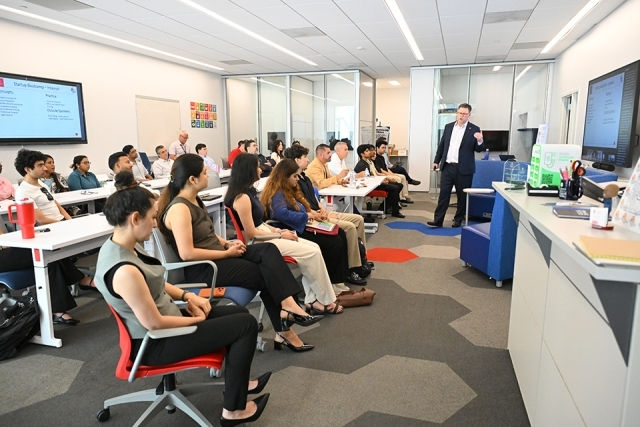
National Innovation Network Annual Meeting: Recognizing Resilience
The National Innovation Network (NIN) gathered for its annual meeting on August 9-11 in Washington, D.C., just shy of celebrating the 15th anniversary of the Innovation Corps (I-Corps) program. Having lasted 15 years, it was fitting that the recurring theme of the convening was “resilience,” as stories of I-Corps’ strength, growth, and adaptability were shared throughout the conference.
NIN is a network of universities, NSF-funded researchers, established entrepreneurs, local and regional entrepreneurs, local and regional entrepreneurial communities, and other federal agencies that helps scientists learn to translate fundamental research results into the marketplace.
The two-day conference, one of the largest ever with 375 attendees, included critical updates on National Science Foundation (NSF) Directorate for Technology, Innovation and Partnerships (TIP) programs, the announcement of new initiatives, and numerous talks on I-Corps issues of key interest to the 130 represented universities and institutions in attendance.
The opening address from Dr. Ruth Shuman, NSF I-Corps program director, and Rebecca Ferrell, the new acting section head, Pathways for Translation at TIP, described NIN’s growth and accomplishments. They also shared details about a new I-Corps initiative in partnership with the National Academy of Inventors and the US Patent and Trademark Office, a collaboration to bridge academic research, commercialization training, and intellectual property education to help innovators turn lab discoveries into market-ready solutions. Shuman also announced that going forward, National I-Corps teams and instructors will be issued credentials badges via Credly, a digital credentialing platform.
“The NIN always provides a great opportunity to connect with and learn from colleagues from across the country,” said Ariella Trotsenko, Technology Scout. “I was especially pleased to see the NY Hub represented throughout, including at some of the most compelling sessions about the future of I-Corps.”

John Blaho, director of CUNY Industrial and Applied Research, led the session “Lessons Learned Using AI in I-Corps Programs,” with panelists presenting on various topics related to AI in I-Corps. Panelists included Arber Ruci, executive-in-residence at CUNY and lead instructor of the NY Hub, Nate Hafer, associate vice chancellor for research innovation at UMass Chan, Jessica Vold of NDSU, Christina Pellicane, instructor for the NSF I-Corps Hub Northeast Region, Keith McGreggor, Professor of the Practice in the School of Interactive Computing in the College of Computing at Georgia Tech, and Sudeep Sarkar, Distinguished University Professor and Launch Dean of the Bellini College of AI, Cybersecurity and Computing at the University of South Florida.
The session explored how AI is being incorporated into I-Corps programming and what we are learning along the way. Speakers highlighted AI’s potential to accelerate the learning timeline while emphasizing the importance of preserving opportunities for reflection. Ruci cautioned that I-Corps participants should never use AI to transcribe interview notes, because reviewing and processing those notes is itself an intensive learning opportunity.
Blaho also led the presentation about MVP Testing Pilot/Post I-Corps Instructions, sharing lessons from efforts to help teams move beyond customer discovery to test assumptions through real-world experimentation and minimum viable products.
This convening also marked the first year of the Tech Scouts initiative, and attendees benefitted from an update on Tech Scout activities, nationally. What started as one Tech Scout per Hub has now grown to more than 120 Tech Scouts across the 13 Hubs. Tech Scouts are focused on helping teams become companies and continue their commercialization journey post I-Corps, navigate NSF TIP opportunities, and cross the “valley of death,” the time before a company has secured external investment and support. Tech Scouts work to move more promising teams and technologies towards commercialization pathways. They leverage NSF TIP programs as well as federal and state grants, investors, and partners to accelerate commercialization and impact.
The second day of the conference featured a “fireside chat” with Erwin Gianchandani, assistant director of TIP. He shared the news of 12 new NSF Regional Innovation Engines and the newly established NSF Tech Accelerators, and how he anticipates they will impact broader I-Corps growth and innovation. Gianchandani spoke of how industry is doing research differently because of I-Corps, and that the NIN is uniquely positioned to fill innovation gaps in government, academia, and industry.
The conference ended with closing remarks from Shuman describing her optimism for Hubs to be foundations of innovation at their universities. She encouraged cross-Hub collaboration, standardizing common practices, and sharing of best practices. Shuman highlighted the success to date of Tech Scouts and spoke of bringing all of the Tech Scouts to the NIN next year. She also shared the impact of I-Corps innovations to date, including $175 Million generated in regional innovation support and $17 Billion in follow-on investment.