The National Innovation Network 2025 Annual Convening: Showcasing Growth
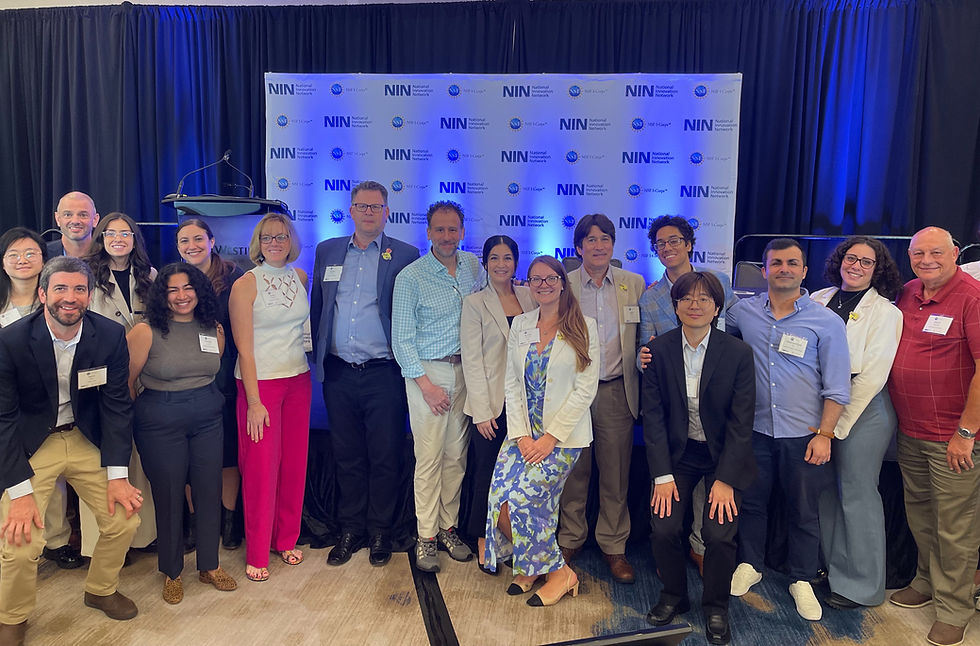
The National Innovation Network (NIN) continues to advance its mission, with every US state now represented by an Innovation Corps (I-Corps) Hub, and the number of Hubs increasing from last year’s ten to an impressive thirteen. This message of growth – and the change and new opportunities it brings – was a recurring theme of the NIN annual convening, held on August 10-12, 2025, in Washington, DC. The conference included critical updates on National Science Foundation (NSF) Directorate for Technology, Innovation and Partnerships (TIP) programs, the announcement of new initiatives, and numerous talks on I-Corps issues of key interest to the 130 represented universities and program staff in attendance.
NIN is a network of universities, NSF-funded researchers, established entrepreneurs, local and regional entrepreneurs, local and regional entrepreneurial communities, and other federal agencies that helps scientists learn to translate fundamental research into products.
The opening address from Dr. Ruth Shuman, NSF I-Corps program director, described NIN’s growth and accomplishments, as well as planned structural changes, including the introduction of Tech Scouts, a new initiative to drive more targeted, enhanced recruitment and support for high-potential I-Corps teams. It was also shared that over the past twelve months, NIN has had more than 350 teams complete the national I-Corps program, with 1,050 participants, and more than 4,000 teams participating in regional I-Corps across the country. Shuman also introduced a new NSF I-Corps logo and discussed how Hubs across the country should prioritize helping the NSF and other agencies tell the story of I-Corp’s impressive economic and community impact.
NIN 2025 Dr. Ruth Shuman, NSF I-Corps Program Director
In describing the successes of regional and national I-Corps, attendees learned that focusing I-Corps cohorts on sector-specific topics, such as artificial intelligence (AI) or environmental tech, often led to positive learning outcomes for participants. Additionally, approximately half of teams going to Nationals have NSF lineage, one-third have Regional I-Corps lineage, and the remaining one-sixth come from SBIR. Overall, National I-Corps participants created approximately $7 billion in economic impact.
The two-day conference was densely packed with presentations and breakout sessions. Of note, Kelly Reardon, program director of the Innovation and Entrepreneurship Program at UAlbany, provided an update on how AI can support rather than replace learning, sharing experiments and lessons learned from running an AI-sector focused regional I-Corps with Arber Ruci, lead instructor of the NY Hub. Additionally, Dr. John Blaho, director of the NY Hub led by CUNY Industrial and Applied Research (IAR), co-led two breakout sessions, one on Usage of AI in Regional & National I-Corps: Continuing the Discussion, and one on Regional I-Corps Alternatives to National Cohorts.
The first day of the NIN conference also included a poster session that showcased 12 posters on I-Corps-related research; as Tech Scouts will replace research, this was the last time research posters would be presented at NIN. Ariella Trotsenko, associate director of the NY Hub, presented a poster on “Analyzing Customer Discovery Platform Usage in I-Corps with InYourEcosystem (IYE).” IYE is a cloud-based course management platform designed specifically for I-Corps training programs developed by NSF I- Corps Instructors in New York in 2017. Dr. YangHyun Kim of CUNY presented two posters on additional NY Hub research along with Vitor Fernandes Marinho Ferreir from Rensselaer Polytechnic Institute.
The second day of the conference featured a “fireside chat” with Dr. Erwin Gianchandani, Assistant Director, and Dr. Barry Johnson, Division Director at the NSF Directorate for Technology, Innovation and Partnerships (TIP); combined, the two have more than 20 years’ experience at NSF. They emphasized the tremendous growth of I-Corps over the past decade, and described opportunities for those both with and without NSF funding to apply for $500,000 to $1.5 million of translational funding through three Translation to Practice (NSF TTP) tracks, two of which require I-Corps.
Gianchandani and Johnson also discussed the renewed priority of improving how the Hubs communicate the impact of I-Corps and how it delivers value to taxpayers, making the case for why research translation matters. Gianchandani also shared that over the past decade, TIP has invested in more than 2,000 startups, resulting in a return on investment of 16 to one; I-Corps has invested more than a half billion in 3,000 teams, delivering $7 billion of economic impact.
Their discussion also examined the opportunity presented by the Programmable Cloud Testbed, a new effort by the NSF to enter the accelerator market. They also shared that Congress is working on SBIR/STTR renewal, and that the NSF is exploring ways to get funding to translation projects more rapidly.
The conference ended with closing remarks from Shuman, encouraging cross-Hub collaboration and sharing of best practices. The 2025 NIN convening also marked the end of a year two rotation for two NSF I-Corps program directors, Dr. Molly Wasko and Dr. Jaime Camelio, who have returned to their home academic intuitions after completing their service.